Heritage
History of Yarm
Yarm appears in the Domesday Book of 1086 and was held directly by the King of England before passing to the ancestors of Robert the Bruce. Its royal market charter dates to 1207, its bridge to around 1400, and in 1821 a meeting at a Yarm pub secured approval for the world's first public railway.
By Yarm.co.uk editorial · Reviewed by Yarm.co.uk editorial · Last reviewed 21 September 2026
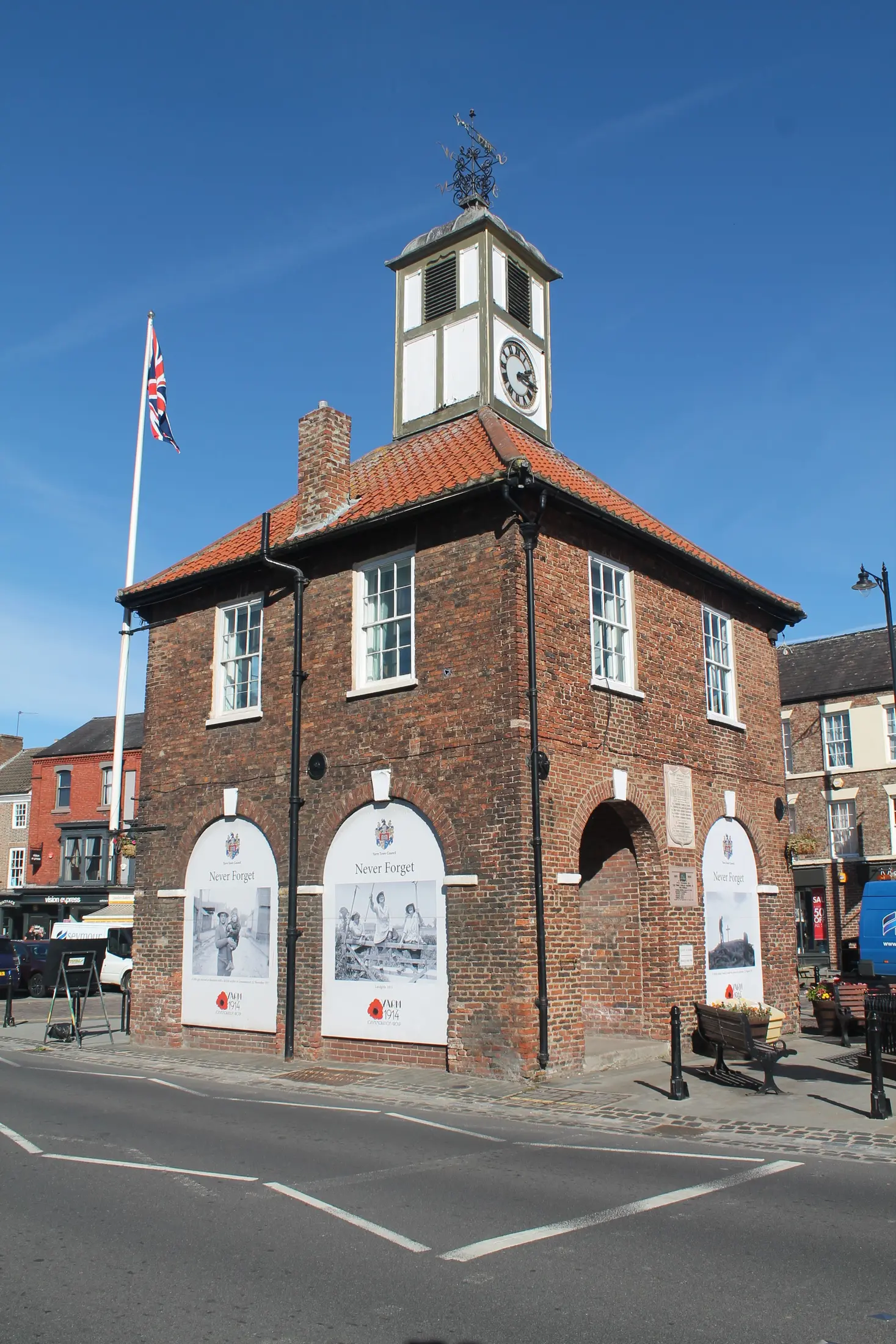
Yarm Town Hall — Lee Bunce, CC BY 4.0, via Wikimedia Commons
Planning summary
Yarm's recorded history stretches back to at least 1086, when it appears in the Domesday Book as land held directly by the King. It later passed to the family that produced Robert the Bruce, received a royal market charter in 1207, and was home to the meeting that approved the Stockton and Darlington Railway in 1821, decades before its own viaduct was built.
Where the name comes from
Yarm takes its name from the Old English gearum, meaning roughly at the place of the fish pools, a reference to weirs built into the river to trap fish. For centuries the town was recorded as Yarum, appearing that way from the 1100s through to around 1300, when the spelling gradually settled into the Yarm used today. It first appears in written record in the Domesday Book of 1086, making it, at minimum, close to a thousand years old as a documented place, and very likely older still.
A King's town, then a future King's ancestors
At the time of the Domesday survey, Yarm belonged directly to the King of England. It stayed that way until the reign of Henry I, when it passed into the hands of Robert de Brus, founder of the noble family line that would, more than a century and a half later, produce Robert the Bruce, King of Scotland. The de Brus family held Yarm for generations, right up until 1272, two years before the future king was even born. Robert the Bruce himself never held the town, but his ancestors ruled it for the best part of two hundred years.
A second royal connection: the King's market
Yarm's royal ties do not end with Domesday. In 1207, King John granted the town a charter for a weekly market, the foundation of its historic status as a market town. That charter is also the origin of Yarm Fair, still held on the High Street every October, a tradition that has run in some form for over 800 years, even as it shifted from trading cheese and livestock to the funfair it is today.
For a short time in the 13th century, Yarm was even classed as its own borough, a formal status it later lost, though the town's market and fair traditions outlasted it.
Friars, a friary, and the family that founded it
Around 1260, Peter de Brus, a member of the same family that once held the town under Henry I, established a Dominican friary in Yarm. Dominican friars, sometimes known as Blackfriars, maintained the friary and an attached hospital in the town until 1583. Their presence is still remembered in local place names today, Friarage and Spital Bank both trace back to them. The site itself was rebuilt in 1770 as a grand house called The Friarage, now part of the grounds of Yarm School.
The oldest residents left evidence behind
Fragments of Anglo-Saxon carved stone survive at Yarm's parish church, St Mary Magdalene, hinting that the site may once have held the grave of an Anglo-Saxon Bishop of Hexham. The town's Viking-era importance is even better documented. In the 1950s, workmen digging pipe trenches in Yarm uncovered a 10th-century Anglo-Scandinavian helmet in remarkably good condition, now known as the Yarm helmet. It remains only the second largely intact Viking Age helmet ever discovered in north-west Europe, and is on display today at Preston Park Museum, a short distance from where it was found. Read more about the museum in the Preston Park Museum and Grounds record.
A river crossing, then a market town
For centuries, Yarm's fortunes were tied directly to the River Tees. Yarm Bridge, built around 1400 for Bishop Skirlaw of Durham, made it the lowest crossing point on the entire river, funnelling almost all north-south traffic between Yorkshire and Durham straight through the town centre. That monopoly on trade and travel lasted more than 300 years, until Stockton finally built a bridge of its own in 1771. Read the bridge's full story in the Yarm Bridge visitor guide.
A High Street built for travellers
For a town this size, Yarm has always had an unusual number of pubs. By 1890, twelve inns were trading along the High Street alone, among them the Black Bull, the George and Dragon, the Crown, the Fleece and the Red Lion, several of which are still open today.
That concentration was no accident. Long before the railway, Yarm sat on a genuine coaching route: from 1823, the daily Expedition service ran between Leeds and Newcastle, calling at Yarm on its way through Stockton, Sedgefield and Durham. Several of the High Street's oldest surviving buildings still carry the tell-tale sign of that era, a wide archway cut through the front of the building leading to a stable yard behind, built for changing tired horses and housing overnight travellers. The Black Bull, dating from the late 18th century, has exactly this feature.
The pub where the railway age began
The most significant moment in any of Yarm's pubs happened at the George and Dragon. On 12 February 1821, a meeting held there secured final approval to build the Stockton and Darlington Railway, the world's first public railway. Thomas Meynell of Yarm presided over the meeting. He went on to lay the very first rail himself in 1822 and later became the railway's chairman. The George and Dragon still stands today, Grade II listed, with a plaque on its wall marking the moment. A branch line reached Yarm itself just a few years later, in 1825, tying the town directly into the birth of the railway age, decades before its own viaduct would rise over the same stretch of river. Read about that later chapter in the Yarm Viaduct visitor guide.
Into the railway age
Yarm's next great transformation arrived in 1852, with the completion of Yarm Viaduct, a 43-arch structure that still carries trains across the Tees today. Built by navvies paid unusually well for the era, at a cost that would run to millions in today's money, it marked the town's arrival in the industrial age, a newer chapter layered on top of nearly a thousand years of history that came before it.
Hospitality never really left
That coaching-era instinct for looking after travellers never disappeared from Yarm, it just changed shape. For over two decades, the town was home to one of the north east's biggest nightlife destinations. The Tall Trees Hotel, once a country house before becoming a small hotel in the 1960s, grew into a 120-room complex with its own nightclub, later known as Club M, that could hold around 7,000 people. Through the 1990s it was one of the region's genuine superclubs, drawing nationally known DJs and famous faces alike, from a former Prime Minister to pop stars of the era.
It closed in 2010, and the site where thousands once danced is a housing estate today. But locals will still tell you that more than a few Teesside couples first met on that dancefloor, and whatever the numbers, Yarm's reputation as somewhere people travel to, stay over, and leave with a story to tell has never really gone away. It carries on today in a different form, in the town's guest houses, bed and breakfasts and self-catering cottages, still doing what the coaching inns and the superclub both did in their own way: giving travellers somewhere good to stay in Yarm. Browse guest houses, bed and breakfasts and self-catering cottages in Yarm today.
A town worth a proper look
It is easy to walk down Yarm High Street and see only Georgian shopfronts and a good place for lunch. Spend a little longer, and a different picture appears. This is a town that once belonged to the King of England, was ruled for generations by the ancestors of Scotland's most famous monarch, and grew rich for centuries as the only place for miles where anyone could cross the River Tees. It hosted the meeting that gave the world its first public railway, and it still carries the viaduct built a generation later to prove it. Not bad for a town of under 10,000 people, and few places this size can make a claim like it. Plan a visit with one day in Yarm or check planning your visit to Yarm for arrival and parking. Return to the Guides hub.
Frequently asked questions
How old is Yarm?
Yarm appears in the Domesday Book of 1086, making it at least that old as a recorded place, and likely older still given its Old English name.
Did a King own Yarm?
Yes. At the time of the Domesday survey, Yarm belonged directly to the King of England.
Is Yarm connected to Robert the Bruce?
Yes, through ancestry. The de Brus family held Yarm from the reign of Henry I until 1272. Robert the Bruce, born in 1274, descended from this family but never held the town himself.
What is the Yarm helmet?
A 10th-century Anglo-Scandinavian Viking Age helmet discovered in Yarm in the 1950s, now on display at Preston Park Museum in Eaglescliffe.
Where was the Stockton and Darlington Railway approved?
At a meeting in the George and Dragon pub on Yarm High Street, on 12 February 1821.
When did Yarm get its market charter?
In 1207, granted by King John. It remains the origin of Yarm Fair, still held every October.
Sources
- Wikipedia: Yarm — Domesday record, de Brus family history, market charter, George and Dragon meeting, and historic inns.
- Wikipedia: Yarm helmet — Discovery, dating and significance of the Yarm helmet.
- Cleveland & Teesside Local History Society: Yarm — Place-name origin and early ownership history.
- England's North East: Yarm and Egglescliffe — Dominican friary founding by Peter de Brus and the Friarage.
- Historic England: A Brief Overview of the Stockton and Darlington Railway — Yarm's role in the founding discussions of the S&DR and the 1825 branch line.
- Gazette Live: Memories of Tall Trees nightclub in Yarm — Tall Trees Hotel and Club M history, closure in 2010.
Retrieved 21 September 2026. Live links used for pre-travel checks.